
Permeable Paving That Drains Itself
A truly porous paving system that absorbs and channels stormwater through the paver itself — keeping surfaces dry, safer, and dramatically reducing runoff. Engineered for everywhere it rains.
Stormwater management built into the paver — not the gaps between them.
Most "permeable" pavers aren't really permeable at all — they're solid concrete blocks with gravel-filled joints. When the joints clog, the surface floods. hydroPAVERS®are different: the paver itself is porous, so water moves through the surface rather than around it.
Manufactured from recycled ceramic tile, bentonite clay, and oxide pigment — then compressed at 1,600 tonnes and fired at 1,200 °C in a 460-metre kiln — each paver becomes a permanent, hard-wearing surface that drains like a sponge and lasts like stone.
hydroPAVERS® meet the initial abstraction requirement of most municipal stormwater guidelines, as the initial 5 mm of water absorbed will evaporate within 24 hours.
Three Stages, One Continuous Flow
A storm event becomes a non-event. Water moves from sky to soil without ever pooling on the surface or overwhelming a drain.
Rain Falls on the Surface
Instead of pooling on top like concrete or asphalt, raindrops are absorbed directly into the body of the paver itself. The material is engineered to be truly porous — water management is built into the construction, not in the joints between blocks.
The Paver Holds & Filters
Each paver can absorb up to a 6 mm rain event before reaching saturation. As water moves through the ceramic matrix, sediments and contaminants are filtered, helping to keep stormwater cleaner before it ever reaches the soil or storm system.
Water Drains to the Base
Excess water passes through the paver and into a prepared base of High-Performance Bedding (HPB) — washed, angular limestone aggregate that drains even when compacted. Stormwater is absorbed back into the ground rather than racing to the nearest storm drain.
Engineered for Performance, Built for the Planet
Every benefit traces back to the same idea: a paver that works with the water cycle instead of against it.
Eliminates Standing Water
Drier, safer surfaces during and after heavy rainfall. No puddles, no slip hazards, no ice patches forming overnight.
L.I.D. Compliant
Helps fulfill Low Impact Development requirements for new construction and stormwater management plans.
Lower CO₂ Footprint
Just 5.6 kg CO₂ per m² — versus 100 kg for traditional Portland-cement alternatives. Made from post-industrial recycled ceramic tile.
Cooler Surface Temps
Moisture trapped in the paver evaporates over time, cooling the surface and reducing the urban heat-island effect around buildings.
Quieter Environments
The porous structure absorbs sound — ideal for transit platforms, courtyards, and dense urban amenity decks.
Award-Winning Design
Recognized internationally and nominated for Green Building Product of the Year. Trusted on residential, commercial, and municipal projects.
Truly Porous vs. Just Permeable in Name
Many "permeable" systems are conventional concrete, asphalt, or interlocking brick with gravel between joints. They're not porous — they just rely on gaps that eventually clog.
Water moves through the material itself.
- ✓Paver body absorbs and retains water until saturation, then drains downward.
- ✓Made from recycled ceramic tile diverted from landfill.
- ✓5.6 kg CO₂ per m² — versus 100 kg for cement alternatives.
- ✓Permeability tested and maintained for the life of the product.
Water relies on the gaps between blocks.
- ✕The brick itself is solid concrete — water has to find the joints.
- ✕Joints clog with sediment, dust, and debris over time.
- ✕Heavy rainfall floods the surface despite the "permeable" label.
- ✕Cement-based, with a much heavier carbon footprint.
From the Ground Up — and the Roof Down
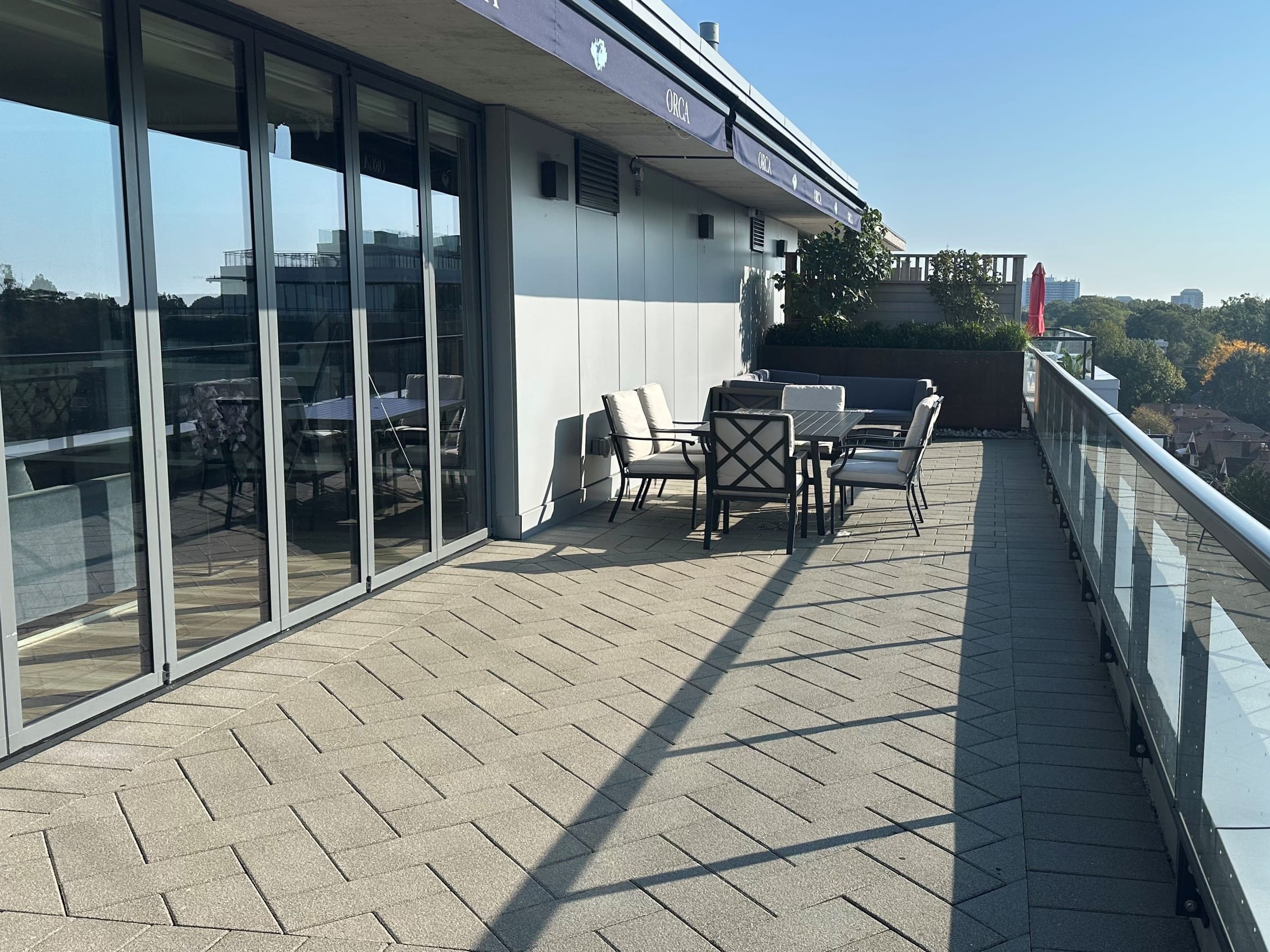
On the rooftop, hydroPAVERS® sit on self-leveling pedestals to create walkable, slip-resistant amenity decks that complement a vegetated LiveRoof system — providing parapet-to-parapet stormwater capture across the entire roof.
Pavers on pedestals retain roughly 6 L/m² per rain event. Paired with GR52 water-retention panels, that capacity grows to over20 L/m² — turning hard surfaces into active stormwater infrastructure.
Anywhere Water Needs to Disappear
From residential driveways to municipal parks — hydroPAVERS® handle projects of any size, in any climate where it rains.
Explore the Full hydroPAVERS® Catalogue
For full technical specifications, colour and size selections, project galleries, installation guides, and downloadable resources — visit our partner site at hydroPAVERS®.
Visit hydropavers.caOpens our partner's official site in a new tab.